
Recruitment has always been a balancing act. Talent acquisition (TA) leaders and managers are constantly pulled in two directions: the pressure to bring in top talent quickly, and the expectation to do it with fewer resources.
Today, that balance feels increasingly impossible. Roles that once attracted 30 – 50 applicants now generate hundreds, even thousands of applicants within a short time frame. According to industry benchmarks, the average job post receives 340 applications, while LinkedIn data shows a steady rise in applicant volume across most industries since 2020. Yet despite this surge, most TA teams are not growing. In fact, many are stagnant or even shrinking. This is the paradox of modern hiring: more applicants, fewer resources, and higher expectations from boards and executives who want quality hires that drive measurable business outcomes.
This guide will explore why recruitment is breaking down, the risks of over-relying on AI screening, and how video screening (when done well) can both improve candidate quality and strengthen the human experience of hiring.
Table of Contents
Why Recruitment Is Breaking Down
Recruitment has seen a signifi cant change across the last few years, and not for the better. Hiring teams are under more pressure with greater expectations, whilst fi nding top talent feels harder than ever before. So, what are the forces that have been driving this change, and what does the research tell us?
The rise of AI-generated CVs
A 2023 survey by ResumeBuilder found that 46% of job seekers admitted to using ChatGPT to write or edit their resumes and cover letters. In the UK, Reed.co.uk reported that one in three applicants are now using AI to enhance their applications.
The result? Hiring teams are fl ooded with professional-sounding applications that may not reflect actual skills or experience.
Candidates feel AI is making the decisions
Applicants are growing wary. A recent YouGov study showed that 58% of UK job seekers believe their applications are being screened by AI before reaching a recruiter. Whether accurate or not, this belief creates distrust. Candidates often feel judged by algorithms, not people, reinforcing the perception that their efforts disappear into a void.
Breaking communication and the human touch
This overload causes another breakdown: communication. Applicants receive automated updates, or none at all, leaving them frustrated and disengaged. TA teams, meanwhile, are too stretched to provide personalised responses. The human touch — the empathy, transparency, and trust that make recruitment a relationship is slipping further away.
Candidates are half right. Their applications often don’t get seen properly, but not because AI is rejecting them. It’s because hiring teams are drowning in volume, with no scalable way to inject human judgement into early screening. This is why new strategies are needed, strategies that reintroduce humanity at scale without a significant investment of resources or time. AI screening has been proposed as a solution to the problem and whilst it has become more eff ective in the last few years, it certainly isn’t without dangers.

The Dangers of AI Screening and Bias
The idea of AI screening sounds great on paper. A truly scalable way to summarise and judge candidates that doesn’t require TA teams to read through CVs or cover letters, that can work through hundreds of candidates in the blink of an eye. However, the reality of how the technology has been deployed has been anything but positive for many candidates.
So, how can TA teams modernise their hiring process and make use of new technology, without breaking the candidate experience or introducing new risk? Before we talk about how to implement the technology well, let’s understand how and why it can go wrong 👇
When AI goes wrong: The Workday lawsuit
In 2023, Workday, one of the world’s largest HR tech providers, was hit with a lawsuit alleging that its AI-driven screening tools were biased against Black, disabled, and older applicants. This wasn’t an isolated complaint, it reignited global concerns about algorithmic bias in hiring.
As of July 2025, the case has been ordered to move forward. There are a few core issues that the case has raised, but the main considerations are whether AI models are susceptible to bias, and who should be accountable for the deployment and eff ectiveness of AI features within the screening and hiring process. Internal hiring teams need to pay attention to the outcome of the case, as there are a significant number of learnings and considerations that should be worked through before the deployment of the strategy.
Proxy and evaluation bias
Bias isn’t a new topic in the world of talent acquisition, in fact, it’s been around for a long time. Whilst teams have actively sought to reduce bias within the process and improve DEI metrics within their business, AI screening introduces additional considerations and risks for internal hiring teams.
Here’s why AI screening is risky:
● Proxy bias: AI models trained on historical hiring data may replicate past discrimination (e.g., favouring CVs from certain schools, companies or characteristics).
● Evaluation bias: AI may overvalue keywords or formatting styles that don’t actually predict job success, struggling to replicate human judgement around transferable skills.
The “black box” problem
Many AI screening tools function as “black boxes.” TA teams input CVs; the algorithm outputs scores and recommendations. But the decision-making logic is hidden, leaving no clear explanation for why a candidate was advanced or rejected. From a compliance perspective, this is dangerous. From a candidate trust perspective, it’s disastrous. Worse yet, it removes control from hiring teams who are adding keywords into an algorithm without the ability to expand and explain exactly what they’re looking for. The end result? Recommendations that feel inaccurate and more like a risk.
How Video Screening Improves Candidate Quality
If AI remains a risky answer to the problem, then how can teams implement other strategies to help them cut through the noise, whilst building trust with candidates and making them feel seen and heard?
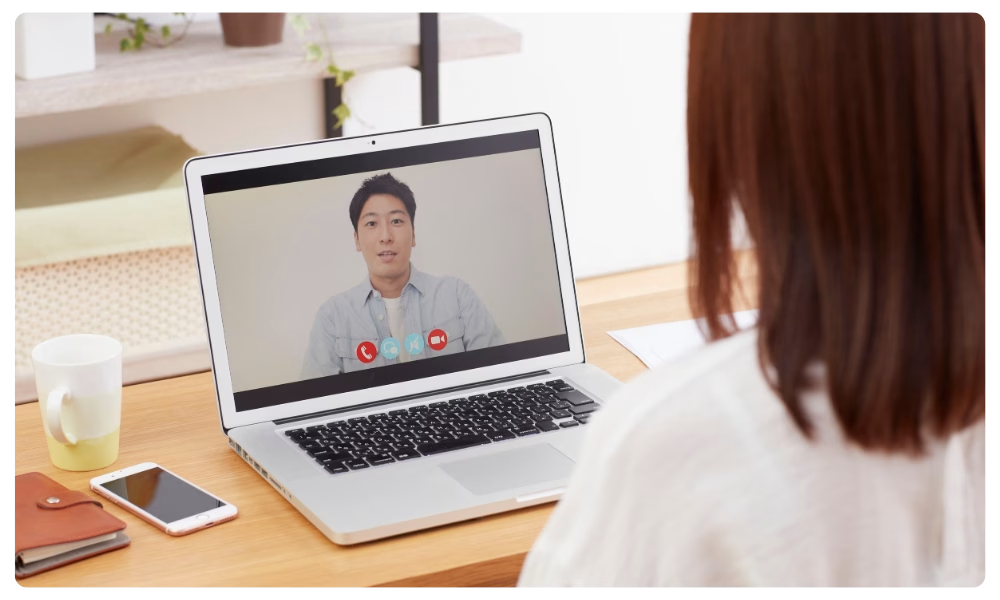
Whilst video screening has often felt like an afterthought or a secondary feature within an ATS, it has the potential to improve the hiring process for both sides. For candidates, it’s a way to showcase themself outside of their CV and cover letter, and for TA teams, it’s a way to screen candidates faster than a phone call without the admin.
Let’s talk about how video screening can help 📹
What video screening is (and isn’t)
Video screening is not a full interview, nor is it a one-way assessment. It’s a structured, short-format video submission that allows candidates to answer a few targeted questions early in the process. Think of it as the humanised bridge between the CV and the interview, and a precursor to a phone screen where you can gather more detail and align with your top candidates.
Candidate quality benefits
Studies back this up. A HireVue survey in 2022 found that companies using structured video screening reported a 31% improvement in candidate quality moving to interviews. Video also helps reduce early-stage dropouts, as candidates who engage with video tend to be more committed.
In short, the candidates who are submitting large volumes of applications using LLMs are unlikely to invest in recording a short video response.
Candidate experience impact
Done well, video screening is seen positively by candidates. They appreciate the chance to show more than what’s on paper. A Modern Hire case study found that 74% of candidates preferred video screening over phone interviews, citing flexibility and fairness.
Of course, it can go wrong. If videos are too long, overly scripted, or lack transparency about their purpose, candidates may feel dehumanised. The key is balance: short, purposeful, and clearly communicated.
In this phase of recruitment, where candidate trust has been waning with the implementation of AI screening, this may feel significantly more human.
How to Video Screen Effectively
We’ve spoken about why video screening should be a strategy in your hiring process, and how it can help alleviate some of the core issues that have been plaguing TA teams for the last 18 months. However, perspective is only useful if it can lead to action and results.
Here’s 6 steps to get started! 🚦
Step 1: Implement strategically
Use video screening for roles with high applicant volume where personality and communication are critical, or where experience plays a major role in fit. Avoid using it for every role, instead reserve it for stages where it adds real value or where skills based screening is more effective than traditional qualifications.
Step 2: Communicate clearly with candidates
Explain the purpose of video screening. (“Get to know you beyond your CV.”) Set expectations (length, format, deadlines). Provide reassurance that real humans will review submissions.
Step 3: Design the right questions
Best practice is 3–5 questions, designed to uncover motivation, values, and role alignment. Rather than trying to include video screening as an assessment, focus on experiences and achievements that feel less like a knowledge exam, and more like a conversation. That way, there’s less risk of candidates resorting to using AI to help generate answers to your questions.
Step 4: Create a fair and inclusive experience
Allow candidates to practice before recording. Provide accessibility options (e.g., captions, time flexibility). Keep questions open-ended but relevant.
Step 5: Standardise review criteria
Develop a scoring rubric (e.g., communication clarity, role motivation, relevant experience) to reduce subjectivity. Train reviewers to use it consistently by implementing kits or guidelines that hiring managers or internal TA members can refer to.
Step 6: Measure and refine
Track strategic and performance outcomes:
● Do candidates who perform well in video screening also succeed in later stages?
● Is candidate satisfaction improving? Is candidate drop off rate reducing?
● Are hiring managers reporting higher quality shortlists? How does interview to hire ratio look after implementation?
Conclusion
Hiring today is harder than ever. Rising applicant volumes, shrinking TA teams, and the rise of AI-enabled candidates have pushed recruitment to a breaking point. Traditional CV-based screening can no longer be relied on, and poorly implemented AI screening introduces new risks of bias, distrust, and compliance headaches.
But there is a middle ground. Video screening, when implemented thoughtfully, offers a way to restore the human touch to hiring. It allows recruiters to see beyond AI-polished CVs, provides candidates a platform to showcase their authentic selves, and improves the overall quality of candidates advancing to interviews.
Video screening helps ensure that remains true whilst building much needed trust and humanisation into the hiring process.